
And how I realized I have never been good at it.
I would consider myself to be a good student. I am confident in my ability to solve problems, I can make the complex connections between subject ideas, and I ask clarifying questions when necessary. Despite all of this, the rewards have never come easily. For a long time, I have believed that this was due to a simple reality that some people are just born with it, wielding a natural ability to absorb and produce information more effortlessly than those who need to really work for it, like me. I thought people were one way or the other, and that it was your personal responsibility to determine how to accommodate your particular circumstance.
I still think there is some truth to this, in that there are students and professionals who are genuinely gifted this way. But now, I have a much different understanding of the disconnect that I, like many others, experience.
In his interview with Johann Hari for the book, Stolen Focus, Sune Lehmann, Professor of Networks and Complexity Science at the Technical University of Denmark, uses this metaphor:
“This drinking from the firehose – there’s just so much coming at us.”
He is talking about the mass amount of material that we attempt to process on a day-to-day basis. Whether it be news articles, social media notifications, or regular conversation, this barrage of information floods our system and overwhelms our ability to focus our attention on any one piece of it.
As a graduate student, you must prepare for the intensified expectations associated with a higher level degree. A very important one is to keep up with recent exploration in your area of study. For my program specifically, this requires an active presence in all things digital and all things media. I am subscribed to several different email outlets that predict and report on trends in short-form video, the productivity of social commerce, and the power of influencers. I follow podcasters who discuss the decline of digital trust and implications of AI-generated content. I am sure that as I progress further into my course load, I will be dissecting full academic studies and even adding my own take on digital media in the same way I am with this blog. Not to mention that many graduate students simultaneously have to balance this work load with a job or career, thus escalating the systemic pressure of information overload.
For a long time, I was clearly under the delusion that the more volume I could hastily gulp from the metaphorical information hose, the more I would learn, much like this dog who truly believes it is successfully lapping up every drop of water from this actual hose.
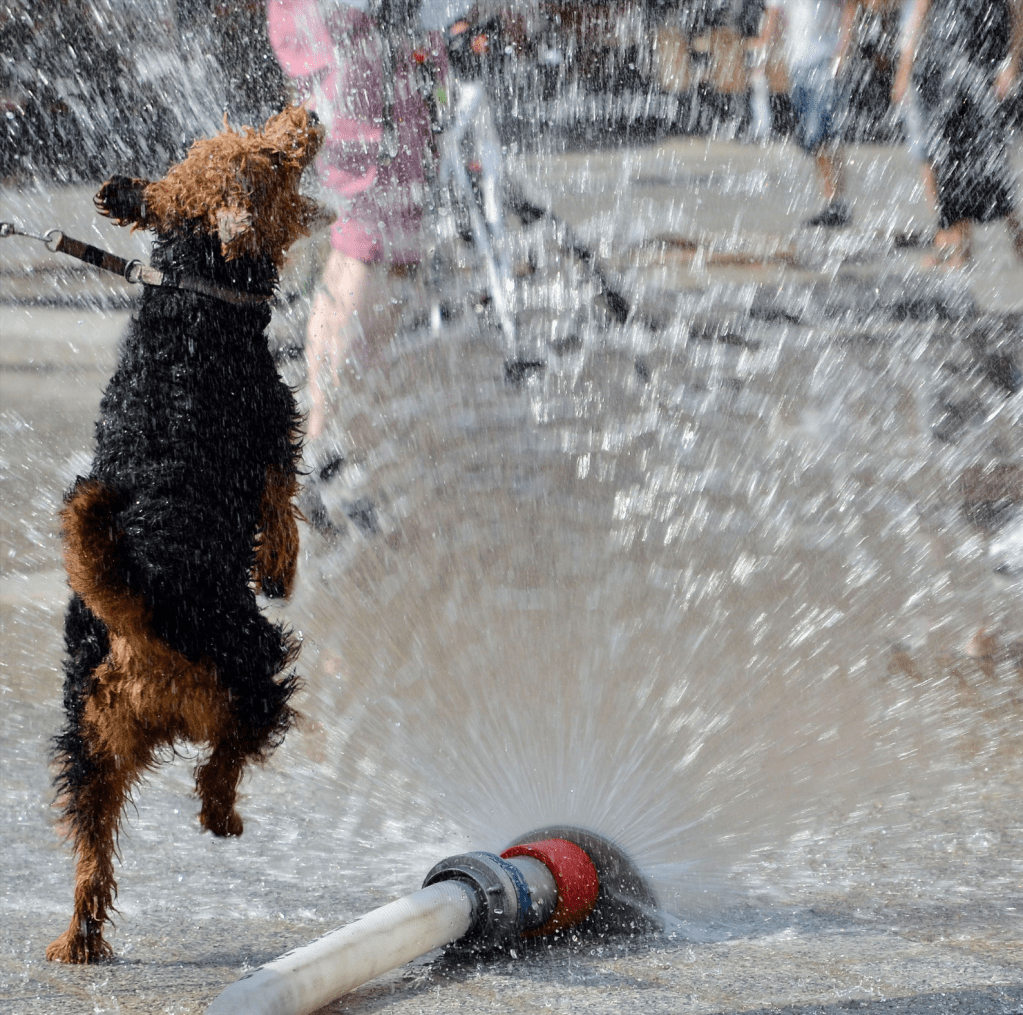
But this was very wrong. I was inundating my ability to process, contemplate – to think. The above mentioned book, Stolen Focus by Johann Hari, allowed me to recognize how exhausted this was making me, and had been making me for many of my years as a student. My inability to decelerate the pace and manner in which I consumed content was depleting my attention resources, as Lehmann called it, and I was not learning nearly as much as I thought I was.
But of course, this is not a problem we have sole control over. A study analyzed in Hari’s book, conducted by Dr. Martin Hilbert at the University of Southern California and Dr. Priscilla López at the Open University of Catalonia, put this into perspective:
“Picture reading an eighty-five-page newspaper. In 1986, if you added up all the information being blasted at the average human being – TV, radio, reading – it amounted to 40 newspapers’ worth of information every day. By 2007, they found it had risen to the equivalent if 174 newspapers per day.”
Johann Hari, on “The World’s Technological Capacity to Store, Communication, and Compute Information”
That was 16 years ago. It would be shocking if this number has not increased exponentially since then. What we, as a society, are experiencing is the sensation that the world is speeding up, moving faster due to the increase in volume of information. This is tiring, and prevents us from the processing and contemplating that is necessary for depth and understanding. It takes time, energy, and focus, all of which are only available to us in finite amounts. We are not learning as easily if our stores are drained.
This is where I have come to realize that I could be doing a little bit more to close the gap between me and those who are naturally gifted in high-achieving performance. Just this week, I have started to implement a few recommended changes from Hari’s book. To put a physical barrier between me and the information hose, I now silence and leave my phone in another room while I do my school work. I have disabled the Messages feature on my laptop so that I cannot cheat and succumb to the texting tap from my friends and family. I even started pasting “do not disturb” signs to my door when I require complete focus and do not want to risk an overload from in-person interaction.
This is an ongoing battle between a manipulative system that wants you to remain soaked under the pressure of mass amounts of information, and the fundamental freedom of simply being able to enjoy this worldly connectedness at a pace we choose. I realize there are many other elements that affect our focus, and I am looking forward to learning about them as I explore Hari’s book. For now, I will do what I can so that I am able to get the most out of my degree, and so that I will have set myself up with the right tools to be successful throughout my journey.
Works Cited
Hari, Johann. Stolen Focus. Bloomsbury Publishing Plc, 2022.
 Hana Lataille
Leave a comment