In an era where our lives are becoming increasingly more entangled with technology, it’s important to reflect on the kind of impact this has on our attention. It is no new fact that the more time we spend on our phones, the more fractured our attention becomes. I elected to take a closer look at my own usage, and the simple yet profound act of how often I check my phone.
For seven days this past week, I gave up TikTok, Snapchat, Facebook, and Instagram. Then, I created a spreadsheet to track the number of times I checked my phone per hour each day. What I aimed to see was 1) the frequency of my phone checking, 2) any patterns that emerged from day-to-day usage, and 3) if my self-imposed app restrictions would decrease the regularity of my phone checking. Whether it was a harmless tap of my home screen to check the time, or thirty minutes worth of mindless scrolling, I recorded it.
Here are my findings, laid out in an Excel sheet:
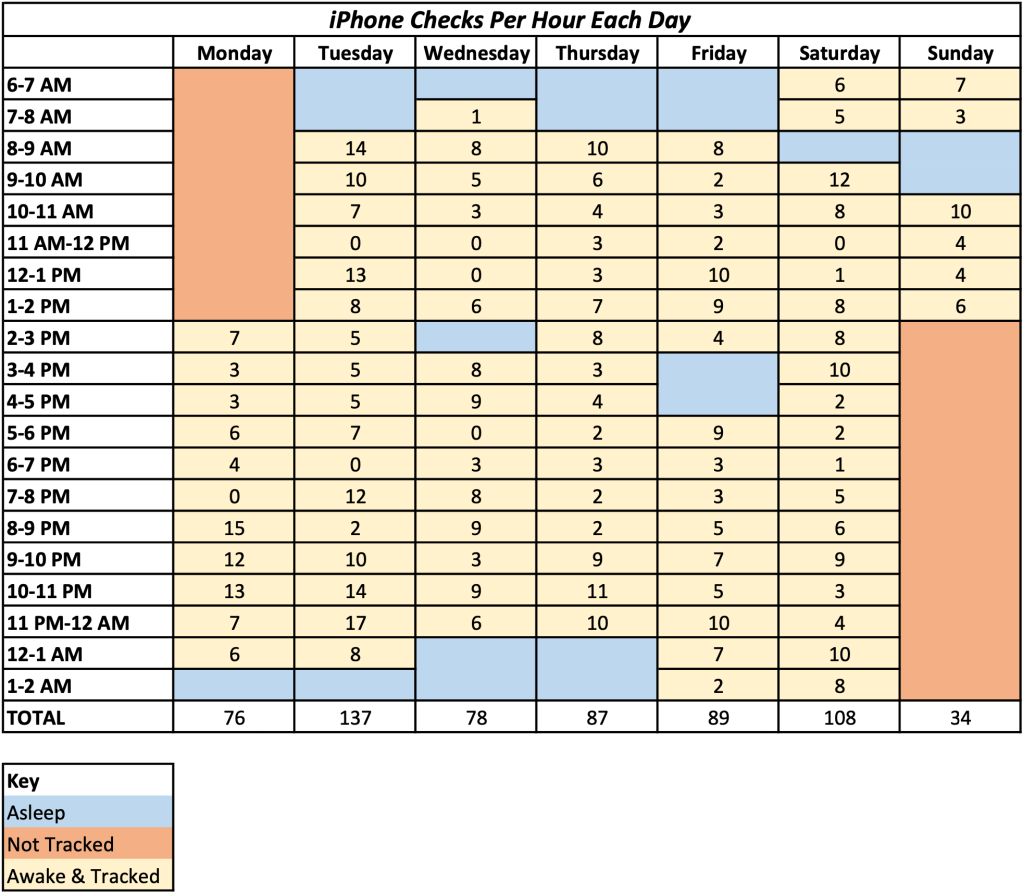
Just looking at the table as is, the numbers don’t paint much of a picture. Taking pointers from Giorgia Lupi and Stefanie Posavec and their analog data design project called Dear Data, I decided to portray my information in a more comprehensible and artistic way:
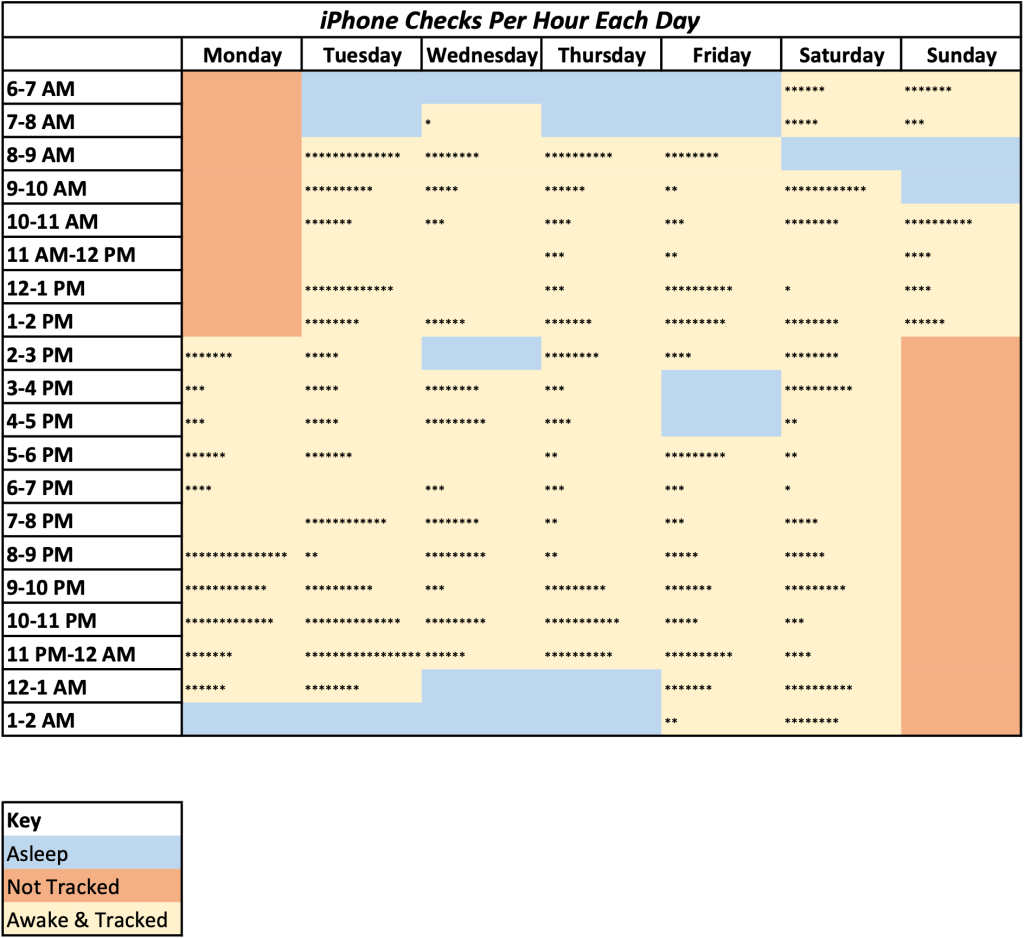
Okay, it’s definitely not as artistic as theirs, but it composes much clearer conclusions, the most obvious being that I’m a phone addict through and through. Every day, I’ve logged increases in clicks that range from as little as zero to as high as fifteen over the course of just one hour. I started four of my past seven days with ten or more phone visits in my first hour of being awake (Saturday and Sunday technically started at 9 and 10 a.m. for me, after having gone back to bed for a few hours post-dog walking).
Further research should eventually lead me to explore the phenomenon behind phone usage in relation to different times of day. For now, I think it’s important to examine the problem as a whole, which is not the phone itself, but rather the systems in command of my incessant phone checking.
Big tech companies have the biggest influence over our attention, or lack thereof. The freedom to choose how we spend our time has gradually been corrupted by a business that exploits our weaknesses. Johann Hari’s Stolen Focus does a great job of putting this into perspective, dissecting how exploitative big tech design really is.
Essentially, tech giants have discovered a quirk of human nature where the more absurd information they can pump you with, the longer you remain online. The longer you’re online, the more your capacity for attention and deep thinking is downgraded. They are profiting off our natural tendencies to latch onto outrageous information through their algorithms that are continuously upgraded to ensure maximum screen time, which is the entire business model of this industry. Since this is only incentivized to get worse, our ability to pay attention is being destroyed, hence the chronic phone checking.
According to research by Dr. Maxi Heitmayer, social psychologist and teaching fellow at the London School of Economics, “89 per cent of smartphone interactions are initiated by the user, with only 11 per cent prompted by an alert from the phone.” To me, this means that companies like Google and Facebook have greatly surpassed their objectives. Instead of needing to deliberately pull us in, we are willing giving ourselves to it. We are conditioned to crave it, and we search for it even when prompts like text tones and brightly colored notifications are absent.
It didn’t really matter that I gave up social media for this experiment, I still found ways to get my fix of phone, and alas, my checking was atrocious in numbers. I touch on a few mindfulness techniques in my recent blog post, and I hope to continue to find ways to reclaim my attention with the appropriate boundaries, management, and mindset.
Works Cited
Giorgia Lupi, et al. Dear Data. Barcelona] Flow Press Media, 2018.
Hari, Johann. Stolen Focus. Bloomsbury Publishing Plc, 2022.
Heitmayer, Maxi. “Screen Time: Why We Can’t Stop Checking Our Phones.” LSE Research, 15 Mar. 2022, http://www.lse.ac.uk/research/research-for-the-world/health/screen-time-why-we-cant-stop-checking-our-phones.
 Hana Lataille
Leave a comment