
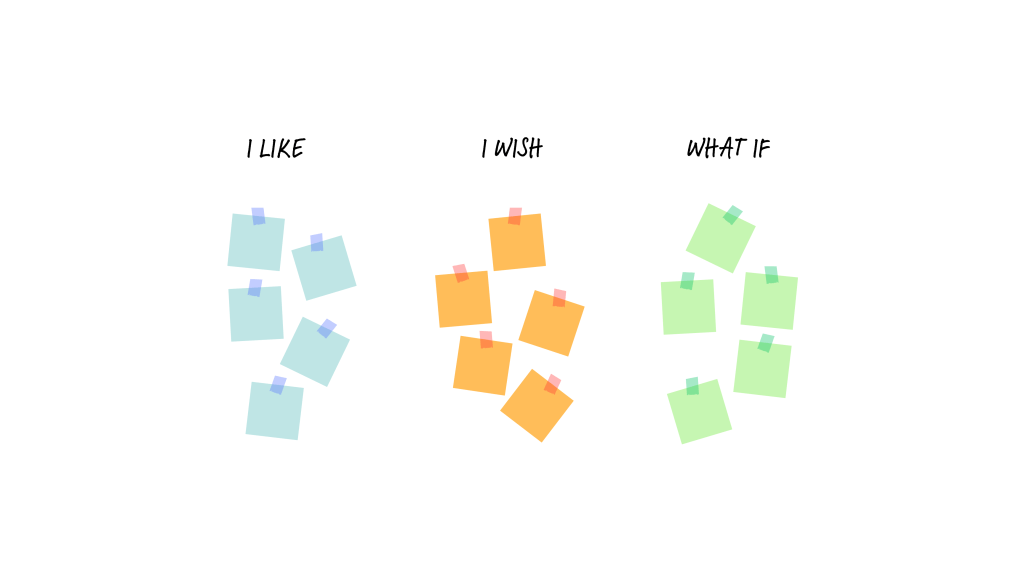
Using sticky notes to organize and analyze IL/IW/WI statements
In the dynamic world of user experience design, user feedback is vital (makes sense, it’s in the name). The vast choice of methodologies to gather insights can seem intimidating, and it may feel like there’s no great place to get your footing. Thankfully, the “I Like, I Wish, What If” (IL/IW/WI) approach is here for you. This simple, yet effective, method provides the information needed to move forward in the decision-making process while fostering an environment for positive, constructive criticism. Here’s how it works:
- After introducing the product or system you’d like feedback on, have your participants describe everything they like about it. They can list their favorite features or general appreciation for the experience that contributes to the success of the product. Beginning with “I Like” statements sets the tone for a positive and open idea-sharing space that becomes crucial in the following steps.
- Next, have your participants list what they wish were different about the product. This can include the smallest of tweaks or even system-wide changes that could be made to improve and address concerns. The feedback from this step will help form user recommendations in the final step.
- Finally, ask your participants to imagine what the product would look like if things were different. They can envision their ideal version of the product and express suggestions which opens the possibility for new ideas to be explored in future development.
Now that you have your data, gather a team to analyze and sort your findings. Look for patterns or common themes that can be used in further research.
Other important things to note about IL/IW/WI
- The straightforwardness of this method allows it to be accomplished through whichever medium you’d like. For instance, you may create a print-out version of these questions where participants can write their answers on one sheet of paper, you may also distribute sticky notes to keep track of each response, or you may even find that a classic whiteboard activity works best. No matter the vehicle, information collection in this approach is designed to be easy.
- This exercise shouldn’t take very long which is favorable for participants but may require deeper research on your part in the future (that’s okay, IL/IW/WI is still a helpful starting point and end-of-study activity)
- Successful exercises require comprehensive feedback. To ensure that you’re collecting meaningful data, you must provide clear instructions for your participants to be as thorough as possible. Your takeaways are only as beneficial as the effort being put in by others, so make sure to set this standard at the beginning of the exercise.
- Remember that both positive and negative criticism will impact the outcome of this approach. To extract the full value, make sure that feedback is framed in positive language, even if the criticism is technically negative. Positivity breeds openness and emotional safety which leads to deeper exploration of ideas (Crawford, 2018).
This method works well in the process of developing user-centered designs because it frames user feedback in way that’s understandable to both the user and the designers. To see this first-hand, let’s look at two experiments that had success with the IL/IW/WI exercise:
Experiments
After learning about an “unconventional” meeting type that was proving insightful for a small business start-up, Balki Kodarapu, technology executive at Pulse, began using the “I Wish. I Wonder. I Like.” method at his own weekly meetings. During these times, employees would begin their sentences with one of those three phrases to make statements as focused as possible. Soon after implementation, Kodarapu noticed that departments were operating more openly and efficiently. The newly established environment significantly boosted the feedback systems within his company, creating exponential improvements (Kodarapu, 2013).
New York City Department of Health and Mental Hygiene
The Community Engagement Group for the New York City Department of Health’s sexual and reproductive justice campaign conducted an evaluation project that involved feedback from a large gathering of people. Due to the size of the group, it was decided that the IL/IW/WI method would facilitate the quickest collection of data. The timeliness proved ideal for participants while the easy-to-understand evaluation process provided researchers a variety of honest feedback (Clark, 2019).
These are just two instances showcasing the IL/IW/WI method in practice, enabling a straightforward evaluation process and yielding valuable feedback. Through the concise framework of three simple questions, this approach accomplishes a great deal with minimal complexity. Give it a try!
Works Cited
Clark, N. (2019, March 22). Try this: I like, I wish, I wonder – Nicole Clark consulting. Nicole Clark Consulting. https://nicoleclarkconsulting.com/try-this-i-like-i-wish-i-wonder/
Crawford, K. (2018, September 12). Design thinking toolkit, activity 14 – I like, I wish, what if. Atomic Spin. https://spin.atomicobject.com/i-like-i-wish-what-if/
Kodarapu, B. (2013, June 3). I wish. I like. I wonder. http://Www.linkedin.com. https://www.linkedin.com/pulse/i-wish-like-wonder-balki-kodarapu/
 Hana Lataille
Leave a comment