We’ve all been there: you’ve brainstormed, researched, organized, and completely set yourself up for success on a project. You take the first few actionable steps of your plan but soon realize you’re stuck. No amount of preparation could’ve predicted this roadblock.
Instead of panicking, use this as an opportunity to pause and reflect. Does this mean your project is doomed?
Not at all.
Does it suggest you should rework your plan a bit?
Absolutely.
You might be familiar with Helmuth von Moltke’s phrase “No plan survives contact with the enemy.” He was talking about war here, but the meaning behind his idea remains true for anything you plan to tackle.
Every project plan should be flexible, evolving as you discover what works best for you and your goals. You should embrace these challenges as opportunities to improve rather than letting them derail your progress.
Navigating My Own Enemy Encounters
As I write this blog post, I’m wrapping up the first week of content creation for my social media campaign, Moment in Matchbook. These last seven days were filed with many unexpected challenges. On one occasion I realized I hadn’t given myself enough time in the visual design phase, and another time I realized didn’t have enough research for a post.
Per the Innovative Management Solutions article, The Critical Role of Flexibility in Project Management Processes, “taking a pragmatic view often reveals tasks that can be scaled back, freeing resources for others with unexpectedly large challenges” (2019). This insight is key, because it’s allowed me to adjust my plan to better manage the scope of tasks and keep the campaign progressing smoothly.
Week 1 Content
Now, on to what it is I did this week.
Citing my Trello project management plan, my five weeks of artifact creation began by adding further research and annotations to my bibliography. My entire campaign revolves around accurate information about matchbooks and matchbook collecting, thus making these efforts some of the most crucial.
I also started a production journal to track my weekly progress. For every task I worked on this week, I entered it with the name of the task, status, duration, and materials it took to complete it. This was a big help for not only holding myself accountable, but also for seeing where those adjustments needed to be made.
Because there are many moving parts in a social media campaign, my Trello board is especially helpful for visualization. With this week involving artifact production, my next task was to start designing.
As I outlined in my project proposal, my campaign consists of four key themes, with each post representing a topic within those main ideas. This week, I chose to create three posts with the following messages:
- Welcome to my page
- Matchbook history
- Matchbook design evolution
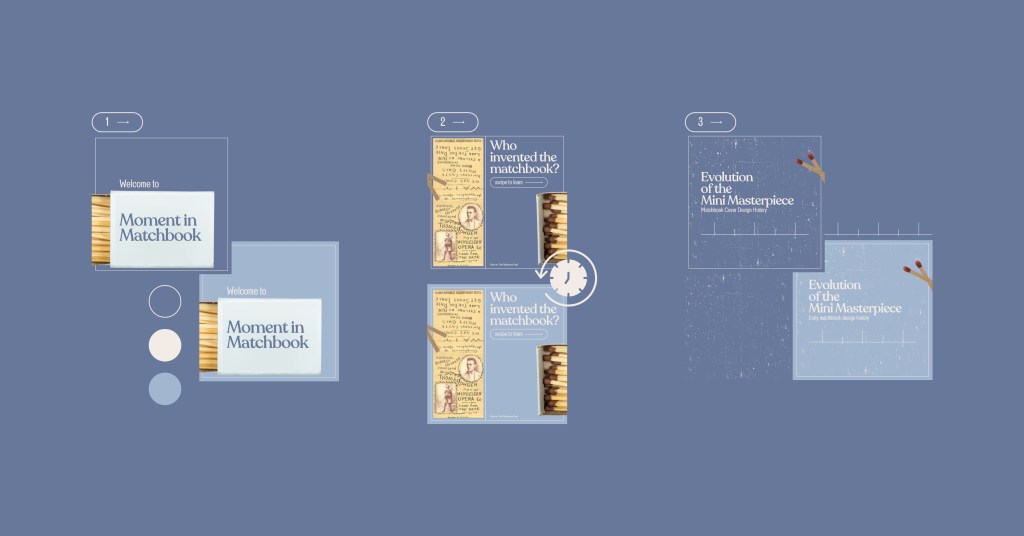
Before diving into the content details, I designed a three-column layout to map out the cover images for each post. This helped me establish the content for each spot and the aesthetic cohesion for my page.
Using my research, I then developed the written and visual content. I’ve included the files from my second post below.
This is where I encountered most of this week’s challenges. Many of my posts will be carousel slides for Instagram and idea pins for Pinterest, thus requiring more substantial information to be shared through those visuals. I underestimated the time it would take me to produce posts that are both eye-catching and educational. Now I know to adjust my plan for next week.
Final Thoughts
This week taught me a lot about my project, perhaps even more than the research itself. I realize it’s impossible to anticipate every turn, making it essential to “expect the unexpected” (Innovative Management Solutions, 2019).
I’m excited to learn more as the weeks progress, and I’m especially excited to apply these lessons as I continue to refine my campaign.
Works Cited
Innovative Management Solutions. (2019, June 14). The critical role of flexibility in project management processes. IMS. https://ims-web.com/the-critical-role-of-flexibility-in-project-management-processes/
 Hana Lataille
Leave a comment