

I’m sure you’ve come across posts online that didn’t obviously scream ‘ADVERTISEMENT’ yet still caught your attention with their promotional feel. If this sounds familiar, you’ve probably encountered native advertising.
What is Native Advertising?
Native advertising has presented itself as a popular method of branded content online, especially on social media. Essentially, it’s a company embedding their advertisement directly into your feed without being too obvious about it.
The official definition, as written by Ray Weaver for the Native Advertising Institute, describes it as “paid advertising that matches the look, feel, and function of the media it appears on” (What Is Native Advertising? The Ultimate Guide, 2024).
Common formats of native advertising include sponsored posts that seamlessly blend into the layout of a blog or news site, or ads on socials that resemble everyday content. If you’re reading this and thinking this doesn’t sound like something you’ve experienced, I’m here to tell you that you most definitely have.
But that’s the point of native ads. They’re far less disruptive than typical forms of advertising, thus giving them the potential to be as engaging as organic content. The more organic they seem, the more effective they are for the companies that employ them.
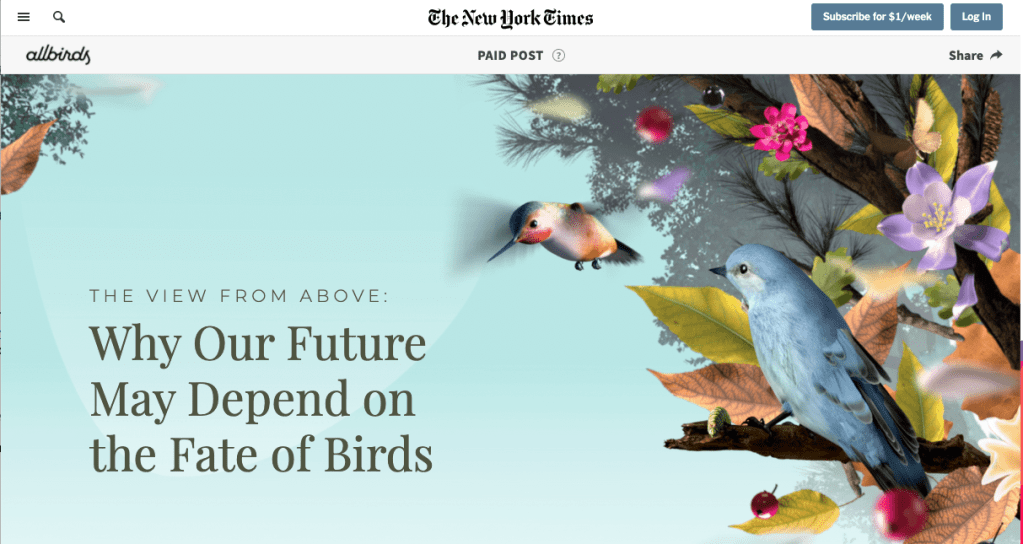
Native advertising works best when content aligns with brand values. For example, Allbirds is highlighting sustainability which not only promotes their products on a major news platform, but also reinforces their company’s core messaging.
Is This Ethical?
This part is tricky, and to be frank, I don’t have a definitive answer to this question. What I do know is that some of the most successful marketing strategies often teeter the line of ethics.
The goal of marketing is to drive business, leaving users to determine which content they can truly trust while online. I’d argue that while native advertising seems great on the surface, there are risks that could affect both the user and the brand lurking beyond the initial appeal.
Dangers of Native Advertising
In his article for the American Marketing Association, 6 Ways to Make Your Native Advertising More Ethical, Hal Conick writes “the problem with native [advertising] is that it does try to confuse the reader” (2019). He explains that the use of native ads is inherently deceptive, as they try to mimic their surroundings to drive conversion and click-through rates. Weaver notes that this type of content “is found to be on par with – or in some cases, slightly higher – than engagement with regular editorial content” (What Is Native Advertising? The Ultimate Guide, 2024).
When brands lack transparency, they risk alienating their audience, and this is especially true of native advertising. Users lose trust in brands that they feel are trying to mislead them, even if the content is well-structured and relevant.
This loss of trust can harm a brand’s long-term content strategy. One example of this came in 2013 when a native ad from the Church of Scientology was published to The Atlantic’s website. Readers clicked on this post, expecting a credible piece about the religion, but were displeased to find a well-disguised piece of marketing. Backlash from this incident forced the magazine to pull the ad, issue a formal apology, and change its policy. Senior vice president Haley Romer later revealed that sponsored content compromised 75% of their revenue.
Not a good look for native advertising.
What Does This Mean for Us?
We, as the audience, must pay closer attention to the posts on our timelines. We need better media literacy skills to figure out if a Facebook graphic is potentially being paid for behind the scenes.
Ethical Standards Suggestions
This also means that we need better regulations in place. Here are a few ways advertisers, publishers, and companies can make sure their native ads are both clear and ethical.
- Transparency: Ads should always be clearly labeled as such, ensuring users understand the kind of content they’re engaging with.
- Accuracy: Content must be truthful and should leave out the pitch, even if it’s promotional.
- Authenticity: Ads should align with brand values to avoid feeling manipulative.
Adhering to these standards should not only prevent users from feeling misled, but also prevent businesses from coming under fire for disreputable practices.
Native Advertising Going Forward
While a seamless user experience is important, standards such as transparency, accuracy, and authenticity are crucial, even if it means a slight disruption.
You might wonder if native advertising would be worth it this way. But remember, most ads are paid for a reason – they’re designed to grab your attention and prompt action. Any content, digital or physical, trying to persuade you to meet someone else’s goal should clearly communicate that intent.
Long-term trust is far more valuable than short-terms gains, and native advertising can still be a powerful tool when used responsibly.
Now more than ever, in an age where technological advancements are rapidly blurring the line of reality, we need to hold ourselves responsible for maintaining ethical values across the digital landscape.
 Hana Lataille
Leave a comment