

Poppi, the prebiotic soda brand, has built a strong presence in the beverage market by blending gut health benefits with vibrant branding and a social media-driven approach. In this audit, I analyzed one of their ads using TikTok Creative Center, evaluating campaign objectives, creative strategy, targeting, and performance metrics. Based on this assessment, I provide three recommendations for optimizing the ad’s effectiveness.
Analyzing the ad’s effectiveness
The ad in question:
Campaign objectives
Poppi’s TikTok ad aims to drive conversions and video views. The goal is to encourage users to visit the website and *ideally* make a purchase while also increasing brand awareness and engagement through organic-style content. However, a notable issue with the conversion aspect is that the link directs users to Poppi’s homepage, rather than a specific product or promotional landing page. This requires extra navigation for users who may have an initial interest but lack the patience to search for the product, potentially leading to lost conversions.
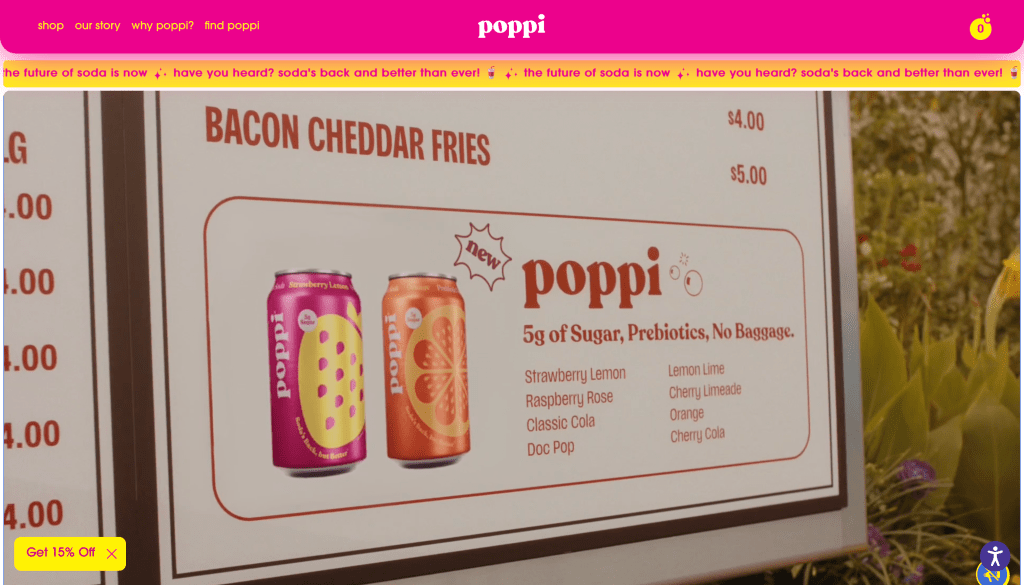
Poppi’s home page, where users are directed via the ad link.
Creative
The ad follows a 35-second product review format, designed to seamlessly blend into a user’s TikTok feed rather than feeling like a traditional advertisement. The creator addresses the camera directly, establishing a conversational and personable tone. This approach builds a connection with the audience, making the content feel authentic and engaging.
The video also incorporates a popular TikTok trend (2025 ins & outs) to remain relevant and relatable. It follows a structured sequence of a product demonstration and review, highlighting both features and benefits. However, one weakness is that there’s no clear CTA in the caption or script, which could limit user action beyond passive engagement.
Targeting assumptions
Poppi’s likely target audience for this ad includes the following segments:
- Health-conscious Millennials and Gen Z consumers looking for functional, low-sugar beverages with gut health benefits.
- Trendy, social-media-savvy shoppers who are drawn to bold branding, influencer marketing, and viral content.
- Those who want a guilt-free soda alternative that’s low-calorie and free of artificial ingredients.
Performance metrics vs. industry benchmarks
Click-through rate (CTR)
Most clicks occur at 2, 7, and 21 seconds, indicating that viewers are engaged enough to interact with the ad at multiple points. While the food & beverage industry average CTR is 0.32% (Mega Digital, Dec 2024), Poppi’s ad ranks in the top 59% of this average. This suggests that while Poppi’s ad is performing decently, there’s still an opportunity to make the creative more compelling to increase click-through rates.
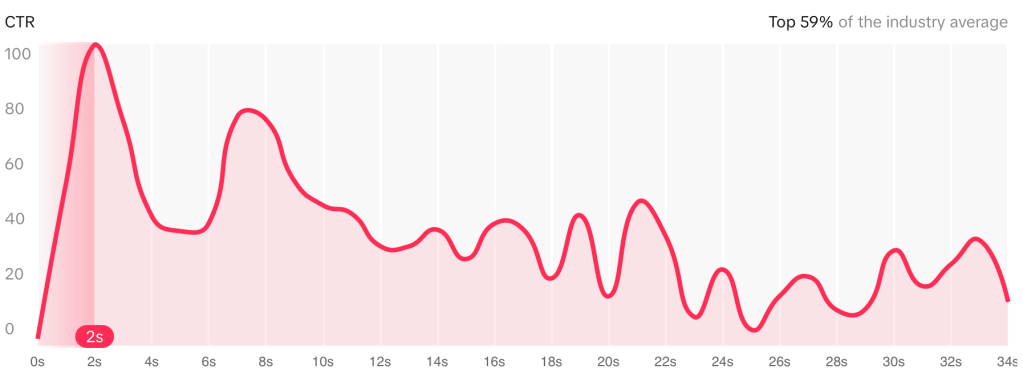
CTR peaks at the 2-second mark, and again at 7 and 21.
Conversion rate (CVR)
Most conversions occur at the 1-second mark, which implies that users who engage immediately are more likely to take action. The ad ranks in the top 36% of the industry average, which is 0.7% for CVR (Mega Digital, Dec 2024). This is a positive indicator that Poppi’s content is resonating with its audience, and that this ad is relatively effective at driving conversions, but additional refinements – such as a stronger CTA – could further improve results.
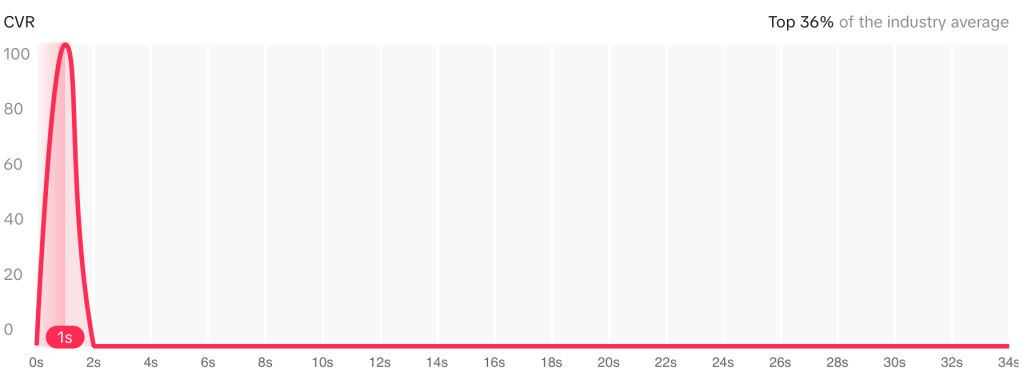
CVR peaks at the 1-second mark, with a significant drop-off after 2 seconds.
Cost per click (CPC)
Most clicks happen at the 1-second mark, which aligns with the conversion data, suggesting that early engagement is key. The average CPC for food & beverage ads is $0.60 (Mega Digital, Dec 2024), and this ad ranks in the top 8%, meaning that it’s highly cost-efficient compared to competitors. This lower CPC tells us that Poppi’s ad is generating a good return on ad spend (ROAS).

Clicks peak at the 1-second mark, with a significant drop-off after 4 seconds.
Retention
The ad ranks in the top 6% of the industry retention average, which is a strong indicator that it holds audience attention better than most competing ads. However, the sharp drop-off within the first 2 seconds signals a need for a stronger hook to keep viewers engaged.
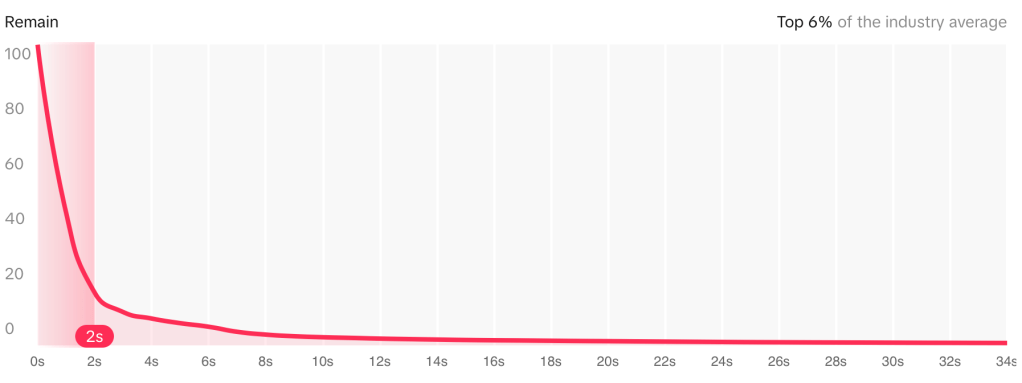
Audience attention falls after the first 2 seconds.
General engagement metrics
The ad’s engagement metrics (below) show that the ad is generating significant interaction, but improving the opening seconds could lead to even higher retention and engagement rates.

What I’m recommending for ad optimization
- Clarify the CTA & landing page: The absence of a clear CTA likely contributes to missed conversion opportunities. Adding a direct verbal and on-screen CTA such as “Tap to Shop” or “Find Poppi Near You” is likely to drive more conversions. Additionally, redirecting the ad link directly to a product page instead of the homepage would reduce friction in the customer journey, making it easier for users to complete a purchase
- Hook viewers in the first 2 seconds: Given the sharp early drop-off, the video’s hook needs to be more visually or verbally compelling. One idea is to start with a close-up product shot to immediately catch attention and a bold opening statement that emphasizes a problem the product solves, then adding text overlays highlighting key product benefits within the first couple seconds. Strengthening this opening moment could significantly enhance viewer retention and overall engagement.
- Experiment with video lengths: A 35-second video is relatively long for TikTok, where shorter formats tend to perform better. A/B testing shorter (15-20 seconds) and slightly longer (35-45 seconds) versions could provide insights into what duration maximizes engagement and conversions. A shorter version might appeal to viewers with limited attention spans, while a slightly extended version could allow for more detailed storytelling, potentially increasing viewer connection with the brand.
Final thoughts
Poppi’s TikTok ad already performs well in engagement and conversions compared to industry benchmarks. However, by refining the CTA, optimizing the first few seconds, and experimenting with ad length, Poppi can further enhance the effectiveness of its paid social media efforts.
This data-driven approach aligns with best practices in marketing. As Sharon Lee Thony highlights in The Marketing Campaign Playbook, “Data-driven marketing is essential for creating campaigns that perform and scale… Data enables marketers to allocate resources efficiently, focus on the tactics that yield the best results, and continually refine their approach” (p. 59). Prioritizing data-driven adjustments will allow Poppi to make more informed decisions and continue improving ad performance over time.
Works cited
Hoang, K. (2024, December 29). Improve ad performance with tiktok ad benchmarks 2025. Mega Digital. https://megadigital.ai/en/blog/tiktok-ad-benchmarks/
Thony, S. L. (2024). The marketing campaign playbook. Independently Published.
 Hana Lataille
Leave a comment