
When it comes to Instagram, visuals are everything, but not all of them perform equally. For social media managers, content creators, and brand strategists alike, there’s an ongoing debate: do still images (photos) or graphics (text-based visuals, infographics, stylized designs) work better on Instagram?
As someone who’s spent a lot of time putting these ideas to the test in actual brand scenarios, I wanted to find out for myself. So, I used Thread By Thread Boutique – a small business local to South Glastonbury, CT whose Instagram I help manage – as my case study.
How Instagram’s Algorithm Plays a Role
Instagram’s algorithm is constantly evolving, but one thing stays the same: it favors content that encourages interaction. Posts that get likes, comments, shares, and saves are more likely to appear higher in users’ feeds and on Explore pages.
As Alyssa Gagliardi puts it in her 2025 breakdown of the platform’s behavior, “Instagram’s algorithms have one goal: to make you stay on the app longer by delivering content you’ll find relevant and interesting.”
That means the format of your post matters just as much as its content. While Reels and Stories dominate the current conversation, traditional static in-feed posts are still a powerful tool… if they’re done right.
Case Study: Thread By Thread Boutique
To explore how visual format affects performance, I looked at data from two recent TBT Instagram campaigns. One set promoted new arrivals, and the other focused on an in-store event. Each campaign included two posts: one photo and one graphic. Messaging and timing stayed the same, only the format changed.
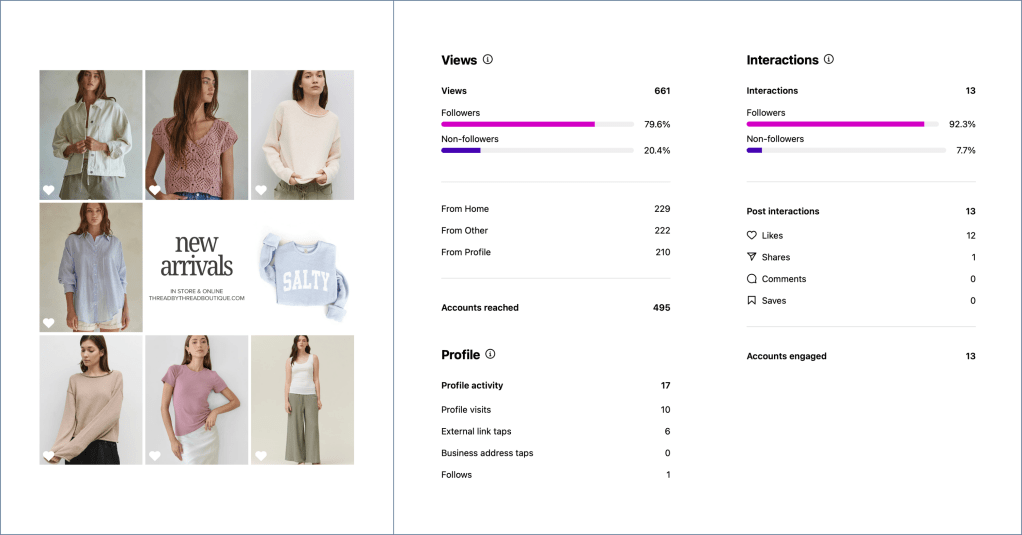
Set 1: Promoting New Arrivals
- Graphic post: 495 accounts reached, 13 interactions (12 likes)
- Photo post: 579 accounts reached, 31 interactions (30 likes)
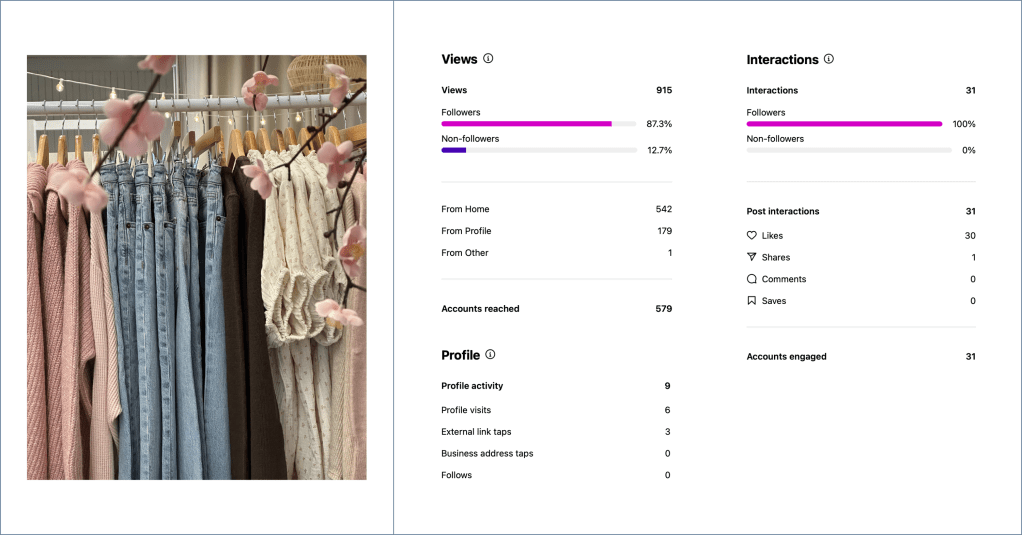
While both posts had similar reach, the photo received more than double the engagement. It clearly resonated more with our audience.
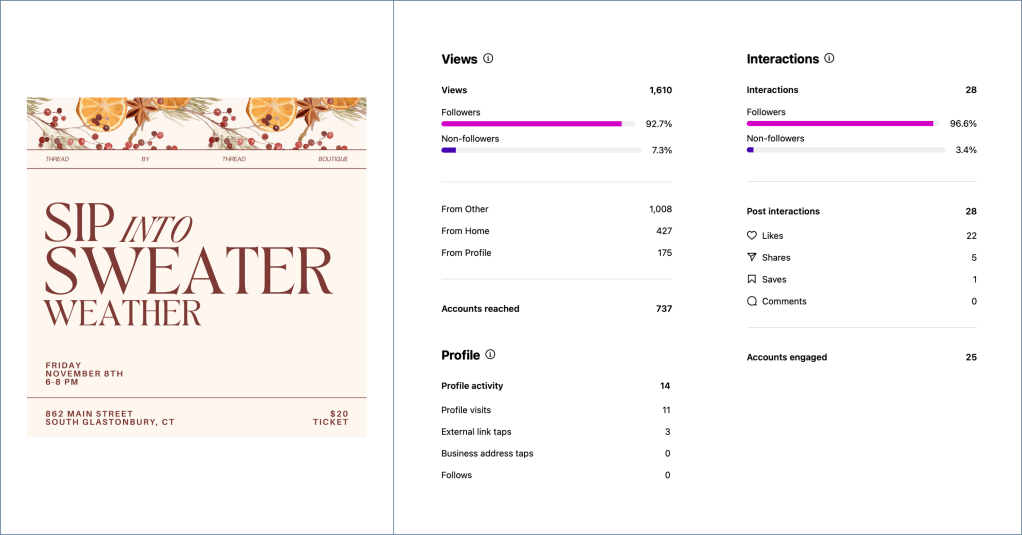
Set 2: Promoting an Event
- Graphic post: 737 accounts reached, 28 interactions (22 likes, 5 shares)
- Photo post: 1,491 accounts reached, 201 interactions (183 likes, 9 comments, 7 shares)
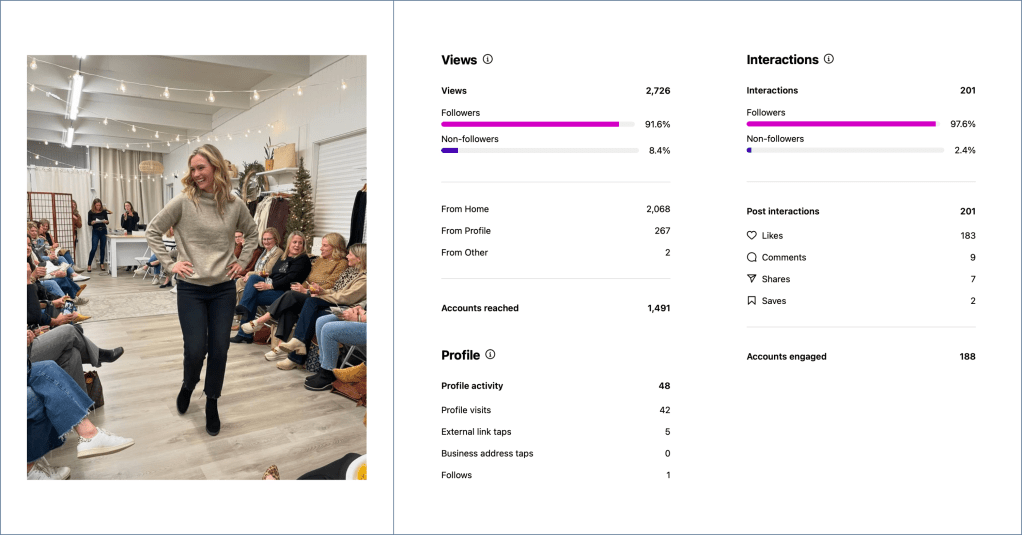
This set revealed an even wider performance gap. The photo post didn’t just reach more people, it drove significantly more engagement (over 7x more), including profile visits and link clicks.
Why It Matters
Across both sets, organic photos consistently outperformed graphics. They sparked more engagement and encouraged more profile visits, even though the message stayed the same.
Why? Photos feel personal. On Instagram, users respond better to content that feels human and relatable. They make the audience feel more connected to the brand. A well-lit product photo or candid event moment blends naturally into a user’s feed, especially if it doesn’t scream “ad.”
In contrast, graphics often come across as promotional and are easier to scroll past. They function more like visual announcements than conversation starters. That doesn’t mean they aren’t valuable – they are, especially for promoting events or sharing key details. But when it comes to driving engagement, photos often deliver stronger results.
That said, it’s not about abandoning one format in favor of the other.
Finding the Right Balance
Even though the TBT data shows that photos tend to perform better on Instagram, that doesn’t mean graphics don’t have a place. They’re great for brand consistency, communicating key messages, and reinforcing your visual identity. In fact, using a healthy mix of content formats helps keep your feed dynamic, and that’s something the algorithm favors too.
In the end, it’s about knowing your audience and leveraging your content types strategically.
So, do photos perform better than graphics? In many cases, yes. But the most effective strategy is one that thoughtfully combines both.
Works Cited
Gagliardi, A. (2025, February 27). How the instagram algorithm works in 2025 (and how to make it work for you). Later. https://later.com/blog/how-instagram-algorithm-works/
 Hana Lataille
Leave a comment