When you tell someone you work in social media, there’s often an immediate assumption: your own profiles must be pristine. Aesthetic grids. Viral-worthy captions. Perfectly timed posts. It’s like people expect your Instagram to double as a portfolio—and maybe even a personality.
But is that really fair? And more importantly, is it necessary?
The Credibility Catch
Sure, a polished personal presence can be a credibility boost. It shows you understand the platforms, follow trends, and know how to engage. It can be especially helpful if you’re just starting out, freelancing, or trying to build a name for yourself. Personal platforms become proof of concept.
Take Sophie Miller, for example—she’s a social media strategist who manages both a personal account and her brand @prettylittlemarketer. Her profiles highlight how you can tailor each presence to serve a different purpose while still staying true to your voice.
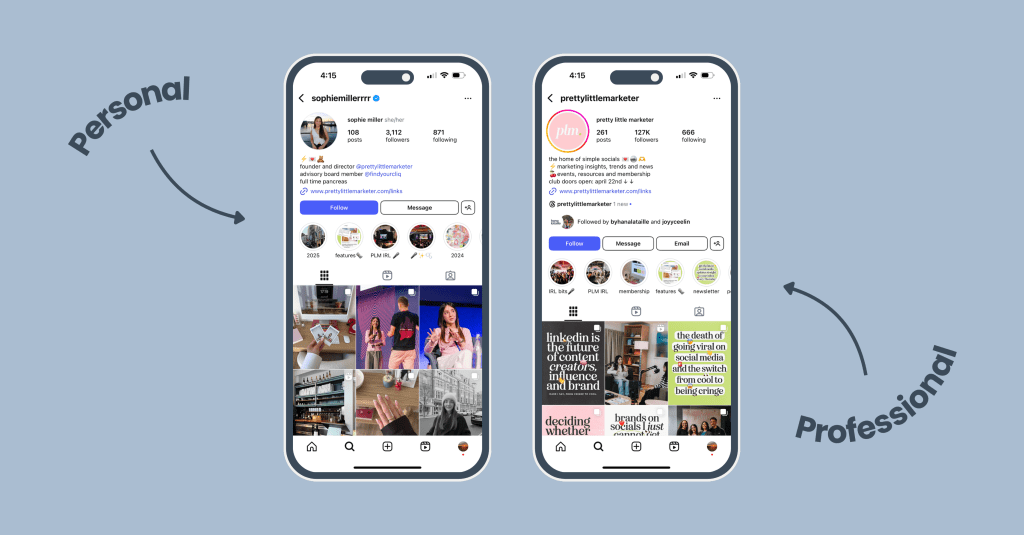
These two Instagram accounts—@sophiemillerrrr (personal) and @prettylittlemarketer (professional)—are both run by social media strategist Sophie Miller. She’s a great example of how professionals can successfully manage both personal and branded presences online, each serving a different purpose.
But here’s the reality: maintaining personal accounts like they’re an extension of your job? It’s a lot. And it’s not always sustainable.
When the Scroll Becomes a Strain
The same tools we use to build and boost brands can become draining when applied to our own lives. Burnout is very real in this industry, and it’s amplified when the line between “online for work” and “online for self” starts to blur.
Michelle Cyca put it perfectly in her piece for Hootsuite, 12 Ways for Social Marketers to Avoid Social Media Burnout: “Social is a demanding role that’s hard to leave behind at the end of the day. ‘Taking your work home with you’ has a more literal meaning when your work is always lurking behind the icons on your phone.” When your job lives in the same apps you use to wind down, it’s hard to ever fully unplug.
It doesn’t help that so many social media professionals feel a constant need to stay visible. According to the same article, 73% of social media managers feel like they need to be “always on”—a mindset that, when paired with burnout, can heighten stress and negative feelings rather than ease them.
To Post or Not to Post? Depends.
There’s no one-size-fits-all answer here—and that’s kind of the point. Whether or not you “should” maintain a personal social presence as a social media pro depends on your goals, role, and energy.
If you’re just entering the field (like I am), building a separate professional account can be incredibly helpful. It’s a place to showcase your voice, perspective, and skills. It’s also a searchable touchpoint for potential employers or collaborators. But that doesn’t mean your personal profile needs to be anything more than just… personal.
On the flip side, seasoned professionals might feel zero pressure to keep their own accounts active. Their work—and reputation—speak for themselves. Some choose to stay entirely behind the scenes, while others enjoy a mix of personal and professional posting. It’s all valid.
So… What’s the Move?
Ultimately, the key is to make your social presence work for you, not the other way around. A few things to keep in mind:
- Define your purpose. Are you trying to attract job opportunities? Share your expertise? Just post life updates for your friends? Knowing your “why” makes it easier to set boundaries.
- Pick your platform(s). You don’t need to be everywhere. Choose the one or two that feel most aligned with your goals or your joy.
- Make it manageable. You’re not a brand campaign. You don’t need a content calendar for your personal feed unless you want one.
- Stay authentic. The best social presence is the one that reflects you, not some idea of what a “social media pro” should look like.
Whether your account is full of strategic tips or just photos from your last coffee run, the truth is: credibility isn’t only built online. It’s built in the work you do, the results you drive, and the relationships you form.
You can practice what you post—but that doesn’t mean you have to post all the time.
Works Cited
Cyca, M. (2022, October 6). 12 ways for social marketers to avoid social media burnout. Hootsuite. https://blog.hootsuite.com/ways-to-avoid-social-media-burnout/
 Hana Lataille
Leave a comment